Agent Loop: Reliability & Verification · Part 6 of 7
Evidence-to-Claim Verification: Why LLM Reviewers Still Fail

An LLM reviewer can spot that an answer is suspicious and still produce an unsafe review.
It may identify the right sentence but assign the wrong error class. It may cite a relevant document without showing that the document supports the claim. It may correctly say that an exact API detail is missing, then invent the detail in its proposed correction.
That is why “ask another model to review it” is not a complete verification methodology.
I built a small, bounded review pilot around an Axum migration answer. The pilot compared independent GLM-4.7-Flash and Qwen3.8-27B runs against the same immutable target answer, evidence bundle, and system instruction. The runner made at most five stateless requests, controlled the endpoint parameters, preserved response statuses, validated the review against a strict JSON schema, and did not invoke Agent Loop or retrieval tools.
The experiment is deliberately modest. It does not establish which model is better in general. It shows why the evaluation contract must score several kinds of correctness separately.
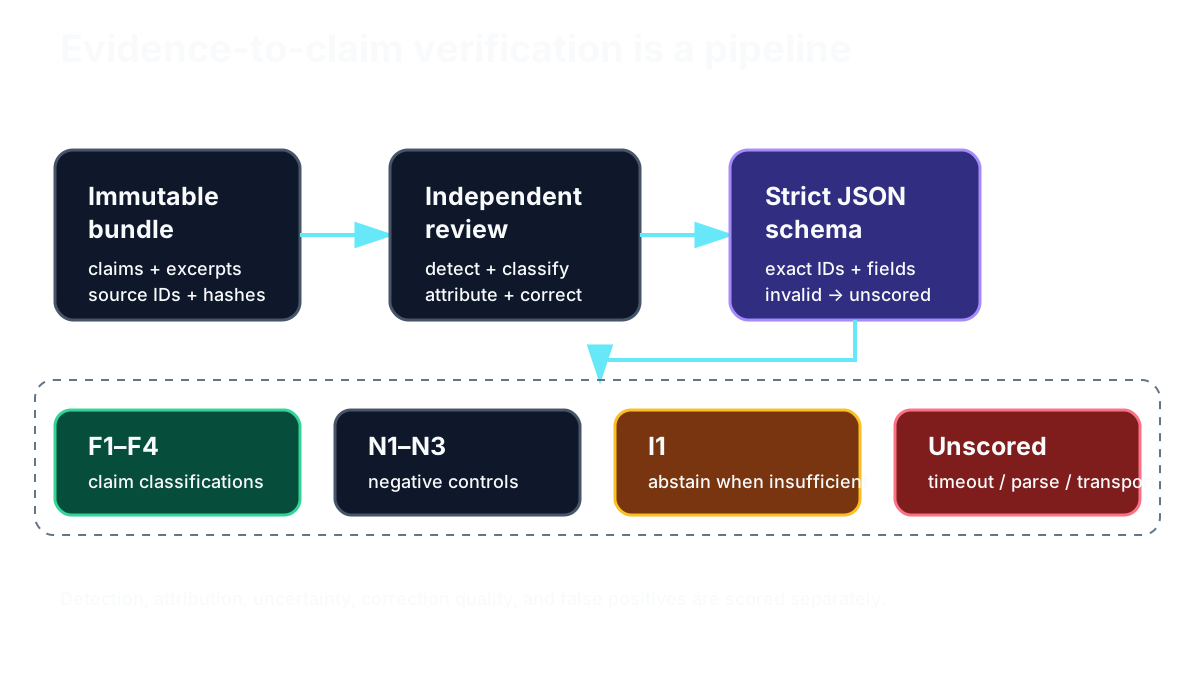
The findings and controls
The current fixture separates four findings, three negative controls, and one insufficiency control. That distinction matters because a review must identify bad claims without flagging claims that the evidence actually supports.
F1 described a list of Axum types and traits as removed. The bounded release-note evidence instead described a change involving the request-body generic parameter. This is a contradiction: the wording changes the subject of the release note.
F2 claimed that no code changes were required because the change was only an internal implementation detail. The evidence did not establish that assurance. The right classification is unsupported, not “supported” and not necessarily “contradiction.”
F3 supplied the exact line:
use axum_extra::extract::TypedHeader;The evidence said that TypedHeader moved to the axum-extra crate, but did not establish the exact import path. The correct response is insufficient evidence with abstention—not a guessed replacement.
F4 asks a narrower question: whether the listed types and traits are no longer generic over the request-body parameter B. The same evidence that contradicts F1 supports F4. Keeping these claims separate prevents a reviewer from confusing “the APIs were removed” with “their genericity changed.”
The negative controls cover the axum::serve example, the TypedHeader crate move, and the axum::body::Body replacement. The insufficiency control asks whether the evidence proves the exact TypedHeader import path; it requires abstention. A reviewer that flags everything, or invents a path for the insufficiency control, is not reliable.
Five dimensions, not one score
The runner kept these dimensions separate:
- Detection: did the reviewer identify the problematic claim?
- Classification: did it distinguish contradiction, unsupported, and insufficient evidence?
- Attribution: did it cite the relevant evidence item?
- Uncertainty: did it state what the bundle did not establish?
- Correction: did the proposed correction stay inside the evidence boundary?
This separation exposed a common scoring trap. A reviewer can set detected: true for F3, cite E3, and still fail because its correction invents axum_extra::extract::TypedHeader. Detection alone measures claim coverage, not safe review.
Similarly, evidence attribution is not the same as evidence sufficiency. Citing E1 does not make an unsupported assurance true. The citation has to establish the claim being made.
The schema is part of the experiment
The review envelope is fail-closed. It must contain exactly findings, negative_controls, and insufficiency_control. Findings must use the expected IDs and fields: detection, one of four classifications, evidence IDs, a non-empty uncertainty phrase, a string or null correction, and an abstention flag. Controls must use the expected IDs and evidence lists. I1 must remain insufficient_evidence with abstain: true and a non-empty reason.
The runner accepts a strictly fenced JSON response as a transport representation, then validates the parsed object against the schema. Empty or truncated generations, malformed JSON, transport failures, and schema-invalid reviews are not silently converted into incorrect or correct reasoning scores; they remain incomplete or parse-error outcomes.
A second pinned Axum follow-up fixture tests a different boundary: three direct contradictions (F1–F3), one supported negative control (N1), and an insufficiency control (I1) for a complete project-specific migration patch. It uses separately hashed target and evidence inputs and shares the same fail-closed validation discipline. This is a follow-up fixture, not an additional claim about model quality.
Immutable inputs matter
The fixture builder extracted the canonical final answer and evidence text from a preserved session, then checked SHA-256 hashes before running the pilot. The expected final-answer hash was:
941e0664e1b26cb13cb06115c0a5fed8d8bc9e8f334ef30141c6250de9208fd9The canonical evidence bundle had its own expected hash:
09f324307c26d108c77f24409131ac864c324dd14be25d710a4ee8c419d265d1The hashes are not scientific evidence about answer quality. They are experiment hygiene: they make it possible to say that GLM and Qwen saw the same inputs.
The runner also treated empty or truncated generations as incomplete rather than incorrect reviews. Malformed JSON was a parse error and was not silently repaired for scoring. That distinction prevents transport and formatting failures from being mistaken for reasoning failures.
What the comparison actually establishes
The pilot establishes that independent model outputs can differ in useful ways, but also that repeated identical outputs are not independent successes. Five byte-identical GLM outputs should be counted as one repeated behavior, not five separate confirmations. The preserved Qwen synthesis runs add an important limitation: the model consumed the available completion budget as reasoning and returned truncated or empty visible content, so those runs are generation-budget failures, not evidence that Qwen made a particular review judgment.
It also shows why a qualitative reading is needed alongside the official rubric. A strict scorer may mark evidence attribution false because a model cites the wrong item even when the model recognized the technical problem. Conversely, a model can receive credit for detection while proposing a correction that is unsafe.
Those observations do not justify ranking GLM or Qwen from a handful of calls. They justify improving the measurement before making such a claim.
A bounded correction is a feature
For evidence review, abstention is not failure. When an evidence bundle says “moved to axum-extra” but not the exact module path, the safe correction is:
The evidence establishes the crate move but not the exact import path.
Verify the path in the versioned API documentation before changing code.
That answer is less satisfying than a code snippet, but it is faithful. A reviewer should not trade evidence discipline for apparent completeness.
The lesson for agent systems
Evidence verification is a pipeline, not a single model call. The system needs immutable inputs, explicit claim IDs, negative controls, parse-status handling, independent runs, and separate scores for detection, attribution, uncertainty, and correction.
Without those boundaries, “the reviewer found an issue” can conceal several different outcomes. The reviewer may have found the issue, misunderstood it, cited unrelated text, and proposed a new unsupported assertion—all in one response that receives a flattering binary score.
The useful question is not “did the model review the answer?” It is “which parts of the verification contract did the model satisfy, and which did it violate?”
Related: When More Evidence Makes an AI Agent Less Reliable and Testing AI Agents With Independent Agents.